


Chevrolet Small Block V8 Engine Rebuild Manual
What's Included?
 Lifetime Access
Fast Download Speeds
Offline Viewing
Access Contents & Bookmarks
Full Search Facility
Print one or all pages of your manual

Contents
Chapter 1 Introduction
How to use this repair manual 1-1
What is an overhaul? 1-1
Engine identification 1-2
Parts interchangeability 1-6
Buying parts 1-11
Chapter 2 Tools and equipment
A place to work 2-1
Tools and equipment 2-3
Fasteners 2-37
Component disassembly 2-41
Gasket sealing surfaces 2-41
Hose removal tips 2-42
Automotive chemicals and lubricants 2-42
Safety first! 2-43
Chapter 3 Diagnosing engine problems
General information 3-1
Reading symptoms 3-1
Measuring oil consumption 3-2
Diagnostic checks 3-2
Is the engine worth rebuilding? 3-11
Chapter 4 Preparing for an overhaul
Preparing to remove the engine 4-1
Removing the engine 4-2
Removing the external engine components 4-11
Chapter 5 Overhauling the cylinder heads
Removing the cylinder heads 5-1
Rebuilding the cylinder heads 5-3
Inspecting the valve springs 5-11
Assembling the heads 5-13
Installing the heads 5-14
Installing the valve train 5-16
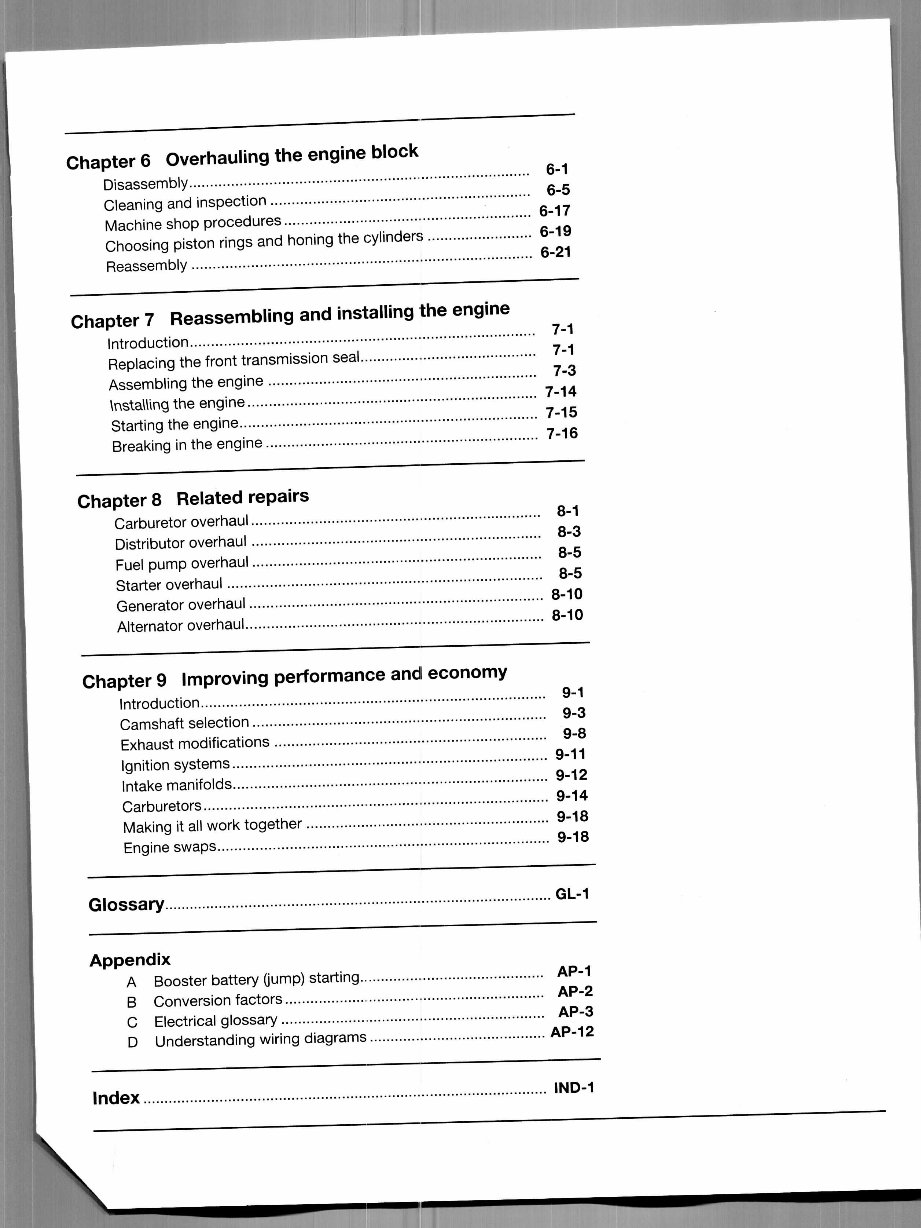
Chapter 6 Overhauling the engine block
Disassembly 6-1
Cleaning and inspection 6-5
Machine shop procedures 6-17
Choosing piston rings and honing the cylinders 6-19
Reassembly 6-21
Chapter 7 Reassembling and installing the engine
Introduction 7-1
Replacing the front transmission seal 7-1
Assembling the engine 7-3
\r\staU\ngthe engine 7-14
Starting the engine 7-15
Breaking in the engine 7-16
Chapter 8 Related repairs
Carburetor overhaul 8-1
Distributor overhaul 8-3
Fuel pump overhaul 8-5
Starter overhaul 8-5
Generator overhaul 8-10
Alternator overhaul 8-10
Chapter 9 Improving performance and economy
Introduction 9-1
Camshaft selection 9-3
Exhaust modifications 9-8
Ignition systems 9-11
Intake manifolds 9-12
Carburetors 9-14
Making it all work together 9-18
Engine swaps 9-18
Glossary GL-1
Appendix
A Booster battery (jump) starting AP-1
B Conversion factors AP-2
C Electrical glossary AP-3
D Understanding wiring diagrams AP-12
Index iND-1
Introduction
How to use
this repair manual
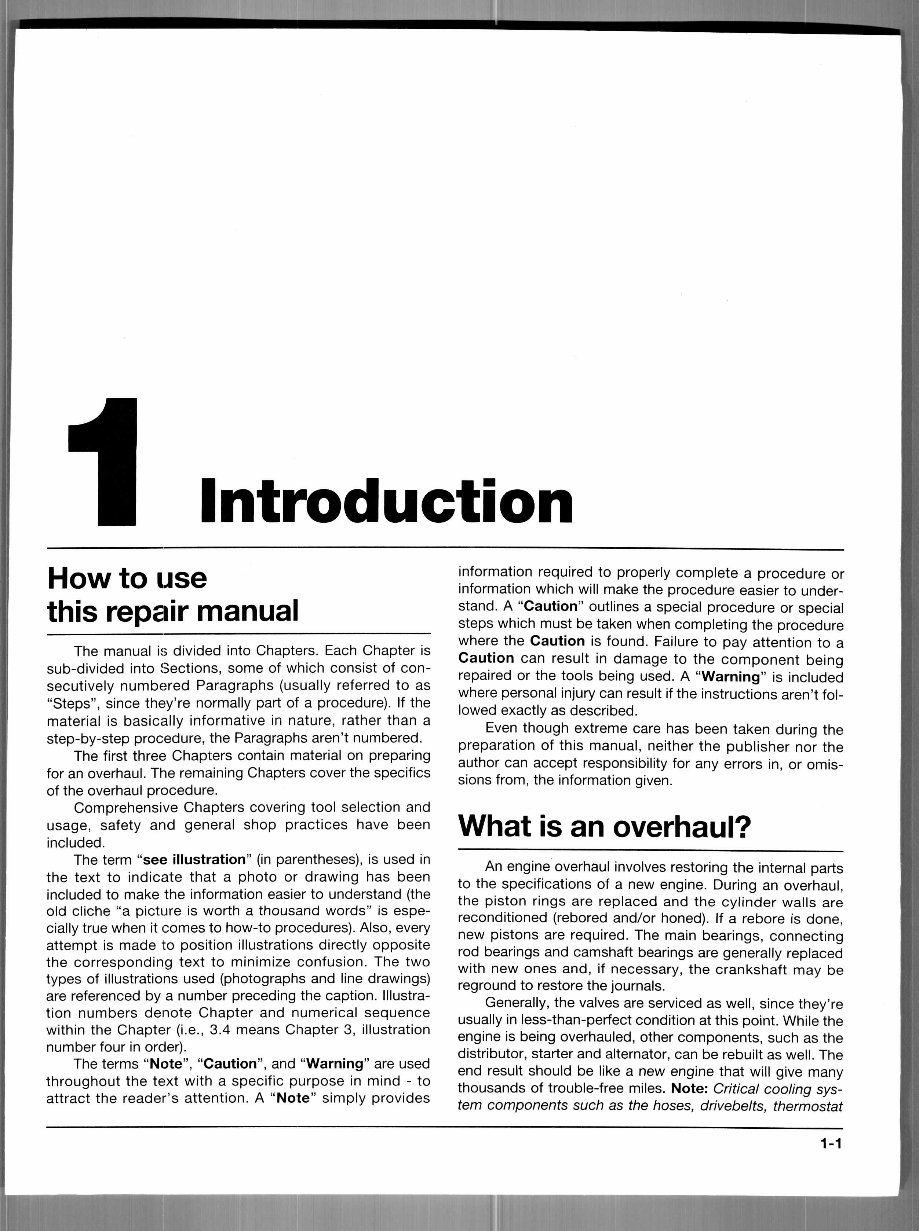
The manual is divided into Chapters. Each Chapter is
sub-divided into Sections, some of which consist of con-
secutively numbered Paragraphs (usually referred to as
"Steps", since they're normally part of a procedure). If the
material is basically informative in nature, rather than a
step-by-step procedure, the Paragraphs aren't numbered.
The first three Chapters contain material on preparing
for an overhaul. The remaining Chapters cover the specifics
of the overhaul procedure.
Comprehensive Chapters covering tool selection and
usage, safety and general shop practices have been
included.
The term "see illustration" (in parentheses), is used in
the text to indicate that a photo or drawing has been
included to make the information easier to understand (the
old cliche "a picture is worth a thousand words" is espe-
cially true when it comes to how-to procedures). Also, every
attempt is made to position illustrations directly opposite
the corresponding text to minimize confusion. The two
types of illustrations used (photographs and line drawings)
are referenced by a number preceding the caption. Illustra-
tion numbers denote Chapter and numerical sequence
within the Chapter (i.e., 3.4 means Chapter 3, illustration
number four in order).
The terms "Note", "Caution", and "Warning" are used
throughout the text with a specific purpose in mind - to
attract the reader's attention. A "Note" simply provides
information required to properly complete a procedure or
information which will make the procedure easier to under-
stand. A "Caution" outlines a special procedure or special
steps which must be taken when completing the procedure
where the Caution is found. Failure to pay attention to a
Caution can result in damage to the component being
repaired or the tools being used. A "Warning" is included
where personal injury can result if the instructions aren't fol-
lowed exactly as described.
Even though extreme care has been taken during the
preparation of this manual, neither the publisher nor the
author can accept responsibility for any errors in, or omis-
sions from, the information given.
What is an overhaul?
An engine overhaul involves restoring the internal parts
to the specifications of a new engine. During an overhaul,
the piston rings are replaced and the cylinder walls are
reconditioned (rebored and/or honed). If a rebore is done,
new pistons are required. The main bearings, connecting
rod bearings and camshaft bearings are generally replaced
with new ones and, if necessary, the crankshaft may be
reground to restore the journals.
Generally, the valves are serviced as well, since they're
usually in less-than-perfect condition at this point. While the
engine is being overhauled, other components, such as the
distributor, starter and alternator, can be rebuilt as well. The
end result should be like a new engine that will give many
thousands of trouble-free miles. Note: Critical cooling sys-
tem components such as the hoses, drivebelts, thermostat
1-1
Haynes Chevrolet engine overhaul manual
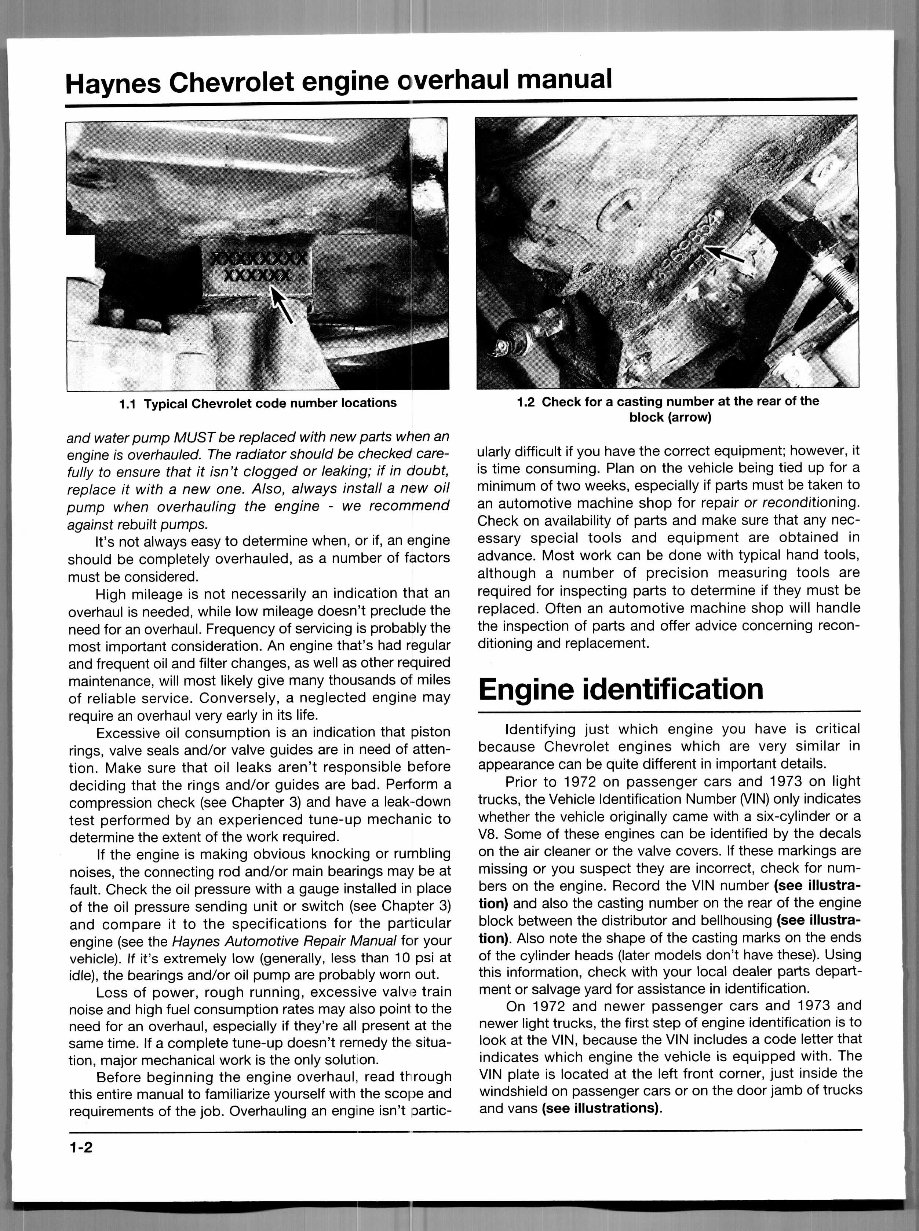
1.1 Typical Chevrolet code number locations
and water pump MUST be replaced with new parts when an
engine is overhauled. The radiator should be checked care-
fully to ensure that it isn't clogged or leaking; if in doubt,
replace it with a new one. Also, always install a new oil
pump when overhauling the engine - we recommend
against rebuilt pumps.
It's not always easy to determine when, or if, an engine
should be completely overhauled, as a number of factors
must be considered.
High mileage is not necessarily an indication that an
overhaul is needed, while low mileage doesn't preclude the
need for an overhaul. Frequency of servicing is probably the
most important consideration. An engine that's had regular
and frequent oil and filter changes, as well as other required
maintenance, will most likely give many thousands of miles
of reliable service. Conversely, a neglected engine may
require an overhaul very early in its life.
Excessive oil consumption is an indication that piston
rings, valve seals and/or valve guides are in need of atten-
tion. Make sure that oil leaks aren't responsible before
deciding that the rings and/or guides are bad. Perform a
compression check (see Chapter 3) and have a leak-down
test performed by an experienced tune-up mechanic to
determine the extent of the work required.
If the engine is making obvious knocking or rumbling
noises, the connecting rod and/or main bearings may be at
fault. Check the oil pressure with a gauge installed in place
of the oil pressure sending unit or switch (see Chapter 3)
and compare it to the specifications for the particular
engine (see the Haynes Automotive Repair Manual for your
vehicle). If it's extremely low (generally, less than 10 psi at
idle), the bearings and/or oil pump are probably worn out.
Loss of power, rough running, excessive valvu train
noise and high fuel consumption rates may also point to the
need for an overhaul, especially if they're all present at the
same time. If a complete tune-up doesn't remedy the situa-
tion, major mechanical work is the only solution.
Before beginning the engine overhaul, read through
this entire manual to familiarize yourself with the scope and
requirements of the job. Overhauling an engine isn't partic-
1.2 Check for a casting number at the rear of the
block (arrow)
ularly difficult if you have the correct equipment; however, it
is time consuming. Plan on the vehicle being tied up for a
minimum of two weeks, especially if parts must be taken to
an automotive machine shop for repair or reconditioning.
Check on availability of parts and make sure that any nec-
essary special tools and equipment are obtained in
advance. Most work can be done with typical hand tools,
although a number of precision measuring tools are
required for inspecting parts to determine if they must be
replaced. Often an automotive machine shop will handle
the inspection of parts and offer advice concerning recon-
ditioning and replacement.
Engine identification
Identifying just which engine you have is critical
because Chevrolet engines which are very similar in
appearance can be quite different in important details.
Prior to 1972 on passenger cars and 1973 on light
trucks, the Vehicle Identification Number (VIM) only indicates
whether the vehicle originally came with a six-cylinder or a
V8. Some of these engines can be identified by the decals
on the air cleaner or the valve covers. If these markings are
missing or you suspect they are incorrect, check for num-
bers on the engine. Record the VIN number (see illustra-
tion) and also the casting number on the rear of the engine
block between the distributor and bellhousing (see illustra-
tion). Also note the shape of the casting marks on the ends
of the cylinder heads (later models don't have these). Using
this information, check with your local dealer parts depart-
ment or salvage yard for assistance in identification.
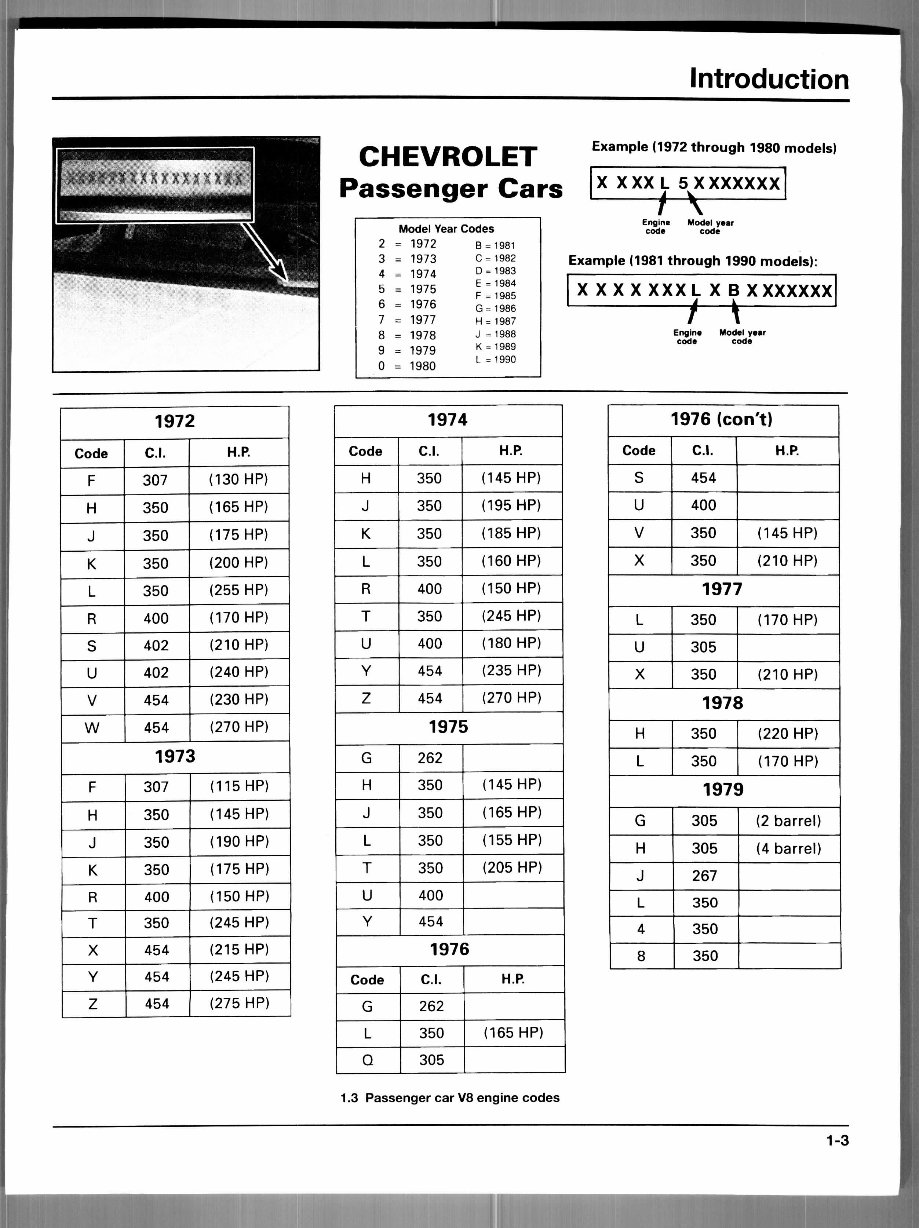
On 1972 and newer passenger cars and 1973 and
newer light trucks, the first step of engine identification is to
look at the VIN, because the VIN includes a code letter that
indicates which engine the vehicle is equipped with. The
VIN plate is located at the left front corner, just inside the
windshield on passenger cars or on the door jamb of trucks
and vans (see illustrations).
1-2
Introduction
CHEVROLET
Passenger Cars
Example (1972 through 1980 models)
Model Year Codes
2 = 1972
3 = 1973
4 = 1974
5 = 1975
6 = 1976
7 = 1977
8 = 1978
9 = 1979
0 = 1980
B =1981
C = 1982
D = 1983
E = 1984
F =1985
G = 1986
H = 1987
J =1988
K = 1989
L =1990
X X XX L S^X XXXXXX
Engine Model year
code code
Example (1981 through 1990 models):
X XXX XXX L X BX XXXXXX
Engine Model year
code code
1972
Code
F
H
J
K
L
R
S
U
V
\N
C.I.
307
350
350
350
350
400
402
402
454
454
H.P.
(130 HP)
(165 HP)
(175 HP)
(200 HP)
(255 HP)
(170 HP)
(210 HP)
(240 HP)
(230 HP)
(270 HP)
1973
F
H
J
K
R
T
X
Y
Z
307
350
350
350
400
350
454
454
454
(115HP)
(145 HP)
(190 HP)
(175 HP)
(150 HP)
(245 HP)
(215 HP)
(245 HP)
(275 HP)
1974
Code
H
J
K
L
R
T
U
Y
Z
C.I.
350
350
350
350
400
350
400
454
454
H.P.
(145 HP)
(195 HP)
(185 HP)
(160 HP)
(150 HP)
(245 HP)
(180 HP)
(235 HP)
(270 HP)
1975
G
H
J
L
T
U
Y
262
350
350
350
350
400
454
(145 HP)
(165 HP)
(155 HP)
(205 HP)
1976
Code
G
L
Q
C.I.
262
350
305
H.P.
(165 HP)
1976 (con't)
Code
S
U
V
X
C.I.
454
400
350
350
H.P.
(145 HP)
(210 HP)
1977
L
U
X
350
305
350
(170 HP)
(210 HP)
1978
H
L
350
350
(220 HP)
(170 HP)
1979
G
H
J
L
4
8
305
305
267
350
350
350
(2 barrel)
(4 barrel)
1.3 Passenger car V8 engine codes
1-3
You're Reading a Preview
What's Included?
Lifetime Access
Fast Download Speeds
Offline Viewing
Access Contents & Bookmarks
Full Search Facility
Print one or all pages of your manual
$33.99
Viewed 53 Times Today


Secure transaction
What's Included?
Lifetime Access
Fast Download Speeds
Offline Viewing
Access Contents & Bookmarks
Full Search Facility
Print one or all pages of your manual
$33.99
This manual provides comprehensive guidance on rebuilding your small block or big block Chevy engine, covering everything you need to know. It is a valuable resource for both professional mechanics and DIY enthusiasts, enabling you to save money by doing it yourself.


